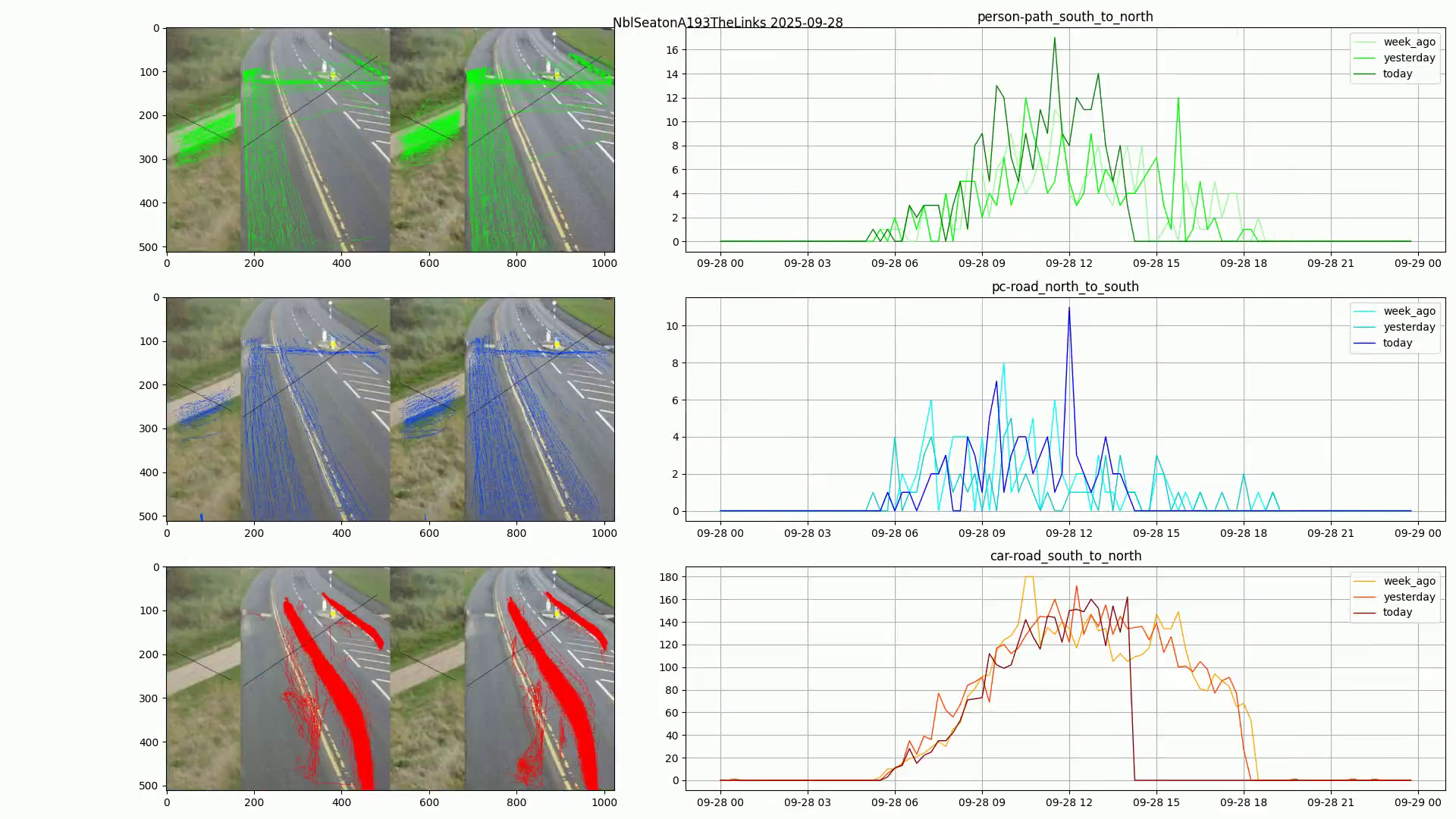
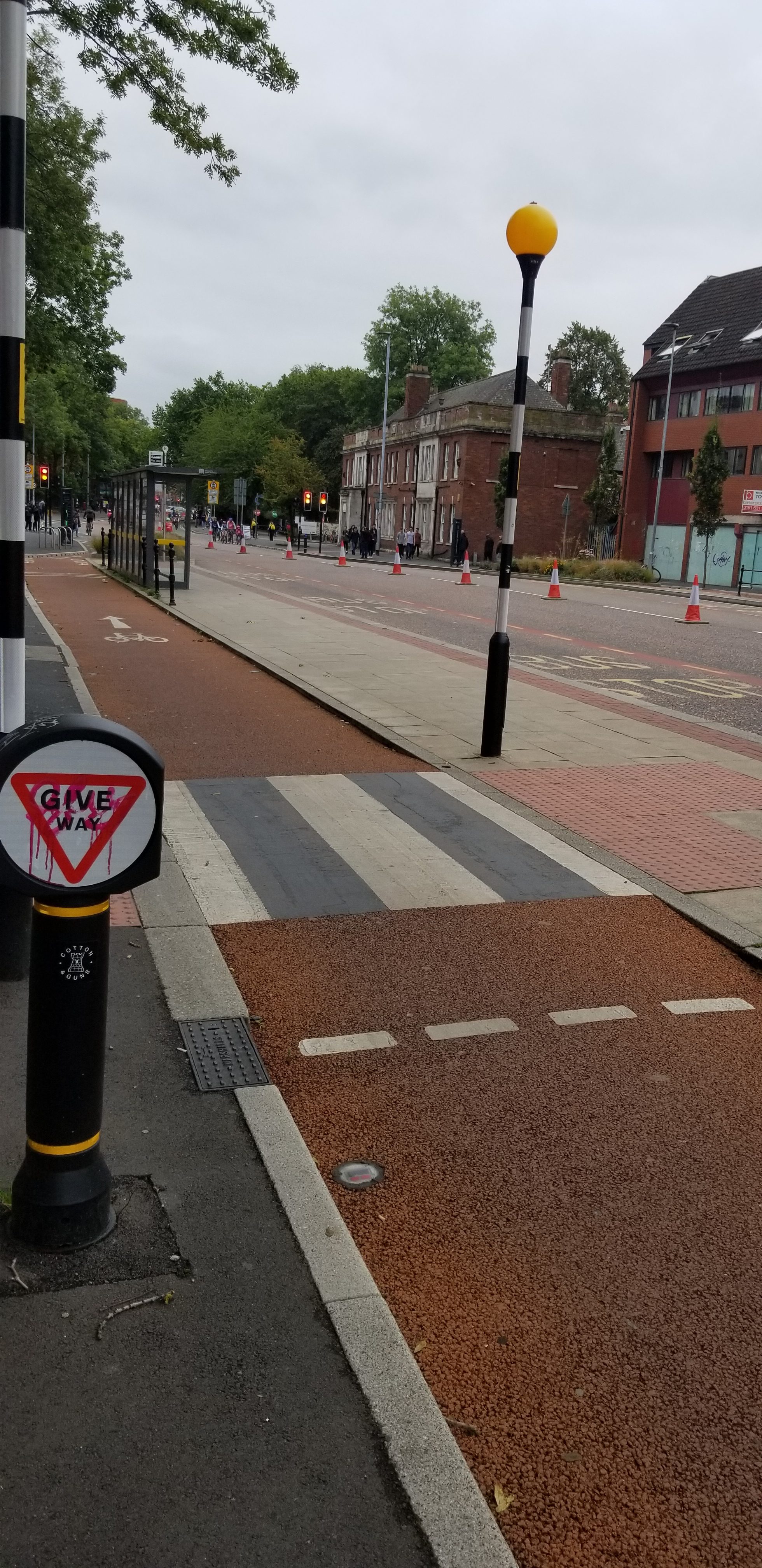
Control rooms and signals teams increasingly need a real-time, accurate picture of network traffic – across walking, cycling, and motor vehicles to meet management duties, incentivise modal shift and support public transport services and emergency access. Modern sensors can publish events and flow as they happen, not just aggregates.
The operational task has shifted from reporting to response. We’re asked to spot yellow-box blocking, protect bus headways, triage queues from roadworks, and calm risky turning behaviour, and do it quickly and with an audit trail.
Where the friction shows up
- Box-junction blocking that propagates upstream and traps buses.
- Banned-turn non-compliance at peaks that undermines crossings and cycle priority.
- Queue build-up spilling across side roads or signalised crossings.
- Speed drops on network corridors after obstructions.
- Pedestrian crowding near stations or crossings creating informal desire lines.
What to stream
Edge devices process and analyse movement locally. They do not need to stream video. Instead, devices emit privacy-minimised messages such as:
- Live counts and speeds by mode and movement as they happen in real-time
- Aggregate counts by mode and movement (or aggregates e.g., 15–60 s buckets).
- Aggregate speeds (rolling percentiles) per approach/link.
- Event flags, for example:
- yellow-box occupancy > N seconds
- stationary vehicle in a cycle lane > N seconds
- banned-turn occurrences
- queue length or groups of stationary vehicles
Protocols that work in practice
- MQTT: Lightweight pub/sub with topic hierarchies (e.g., city/site123/events/box_junction). Messages are retained where it’s safe to present a last known state.
- WebSocket: Full-duplex channel—useful for interactive dashboards.
- AMQP: For larger estates, forward from field brokers into a central bus for scaling, replay and multiple consumers (operations, analytics, archive).
Sample payloads and topics
A compact per-object observation aligned to your requested fields. Optional fields are included where relevant. Example payload:
{"datetime": "2025-09-29T14:03:27.418Z", "sensor_id": "city_centre_junc_12", "lane": "northbound_bus_lane", "location": { "lat": 54.977565, "lon": -1.611381 }, "bearing": 350, "class": "car", "speed": 18.3, "unit": "mph", "data_version": "1.3.0"}
- datetime: ISO-8601 with milliseconds and timezone (UTC recommended).
- sensor_id: human-readable, stable identifier.
- lane and speed: optional—include when the site is lane-segmented or speed is measured.
- class: a controlled list (e.g., pedestrian, cycle, “wheeling”, motorcycle, car, van, rigid_hgv, artic_hgv, bus).
Event example (box-junction blocking):
{"event_id": "evt-7b9d3a20", "type": "box_junction_occupancy", "site_id": "city_centre_junc_12", "location": { "lat": 54.977877, "lon": -1.611501 }, "started_at": "2025-09-29T14:05:12.102Z", "ended_at": "2025-09-29T14:05:37.574Z", "duration_s": 25.5, "data_version": "1.3.0"}
UTMC/DATEX II
We recognise that UTMC and DATEX II are typically used for periodic, aggregated values rather than low-latency event streams. Where you have legacy systems that expect 1-, 5- or 15-minute aggregates, we offer practical IT consulting to bridge the gap: designing and implementing adapters that buffer and window real-time messages (e.g., MQTT/WebSocket) into aggregates, map schemas to UTMC/DATEX II objects, and handle back-pressure, QoS, and replay safely. We can stand up a lightweight broker and transformation layer, and run shadow tests so your existing control and reporting tools receive the values they expect without a wholesale platform replacement.
Keeping actions auditable
Operational decisions are often made under time pressure. That makes a light audit trail useful rather than bureaucratic. We keep all structured notes from each alert: what was observed, conditions surrounding the event, and when the situation recovered.
Implications for planning
Real-time streams are most useful where decision-rights exist (signals, bus ops, enforcement). Recording actions and tying them to trigger events will allow you to make better decisions in the future, and leverage early warnings from your fleet of sensors.
If you’re shaping a live operations plan, we can help choose an optimal streaming approach, and set up API sharing with your existing systems.